How High-Wattage Modules Can Optimize Commercial Solar Projects
Commercial solar projects often have one clear objective: generate the required solar capacity while making efficient use of the available installation area.
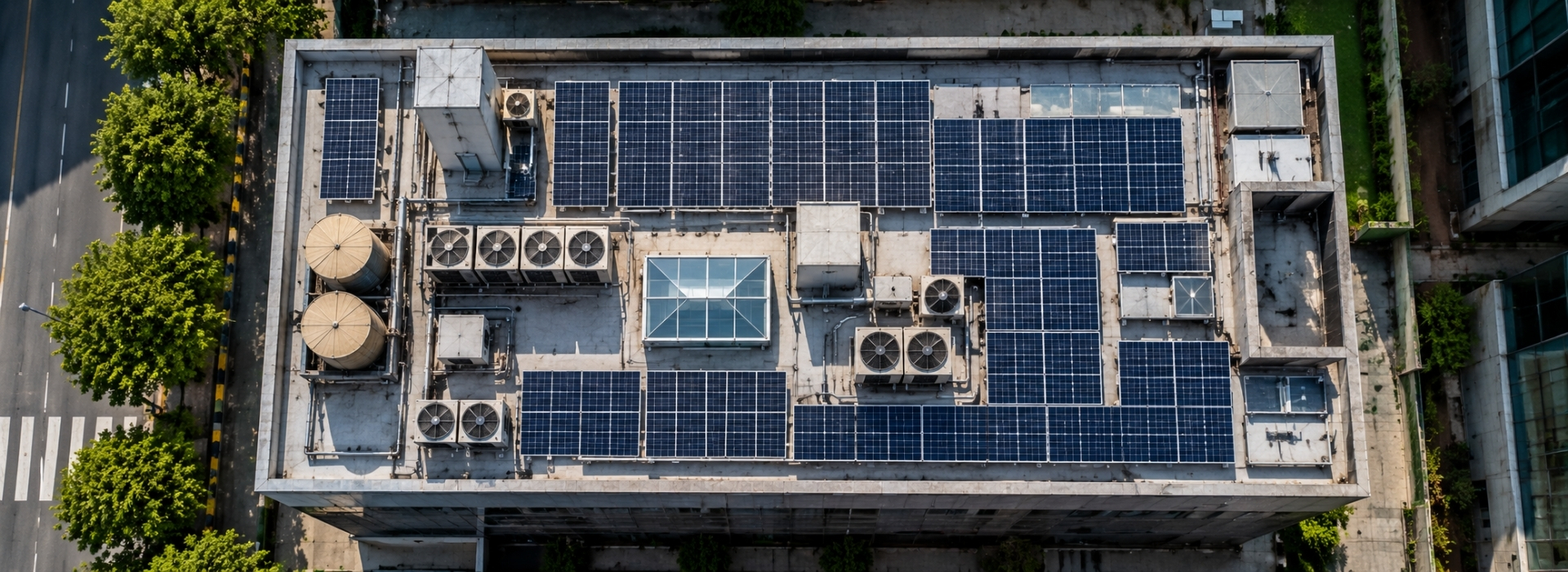
Unlike large open ground-mounted plants, commercial rooftops can have limitations such as HVAC systems, water tanks, access pathways, structural restrictions, and shaded areas. These factors reduce the usable space available for solar modules.
This is where high-wattage solar modules can become an important part of project planning.
Consider a typical commercial project where an EPC needs to achieve a high system capacity within a defined installation area. By evaluating higher-power modules along with efficiency, dimensions, electrical characteristics, and inverter compatibility, the EPC may be able to create a more optimized system layout.
The Project Challenge: Limited Usable Space
Imagine a commercial facility planning to install a rooftop solar system.
The total roof may appear large, but not all of it is available for solar installation.
The EPC may need to account for:
- HVAC equipment
- Water tanks
- Maintenance pathways
- Fire-safety access
- Shaded areas
- Structural limitations
- Required module spacing
After these considerations, the actual usable rooftop area can be significantly smaller.
The challenge is therefore not simply:
“How many solar panels can fit?”
The better question is:
“How can we achieve the required capacity using the available usable space?”
Comparing Lower and Higher-Wattage Modules
Suppose the project requires approximately 1 MW of module capacity.
For a simple theoretical comparison:
With 500Wp modules, approximately:
1,000,000 W ÷ 500 W = 2,000 modules
With 720Wp modules, approximately:
1,000,000 W ÷ 720 W = 1,389 modules
This simplified example shows that a higher-wattage module can reduce the number of individual modules required to achieve a similar rated project capacity.
However, this does not automatically mean that 720Wp is the better option.
Module dimensions, efficiency, weight, electrical characteristics, roof layout, structural design, and inverter compatibility still need to be evaluated.
Fewer Modules Can Influence Project Design
When a project can achieve its required capacity using fewer modules, several parts of the installation may be affected.
Depending on the engineering design, this can potentially influence:
- Number of module-level connections
- Mounting requirements
- DC cabling
- Installation planning
- Module handling
- Layout complexity
- Maintenance access
For large commercial projects, small improvements at the module level can become more significant when multiplied across hundreds or thousands of panels.
This is one reason EPC companies increasingly evaluate high-power modules during the early design stage.
N-Type TOPCon Technology Adds Another Dimension
Modern high-wattage modules are often based on advanced technologies such as N-Type TOPCon.
TOPCon technology is designed to support high conversion efficiency by reducing certain electrical losses within the solar cell.
For commercial projects, higher module efficiency can be particularly valuable when usable installation space is limited.
Instead of looking only at the wattage printed on the module, EPCs should therefore consider:
Wattage + Efficiency + Module Area
together.
A higher-wattage module that also offers strong efficiency can help improve the amount of installed capacity achievable within the available project area.
Can Bifacial Modules Add More Value?
If the selected high-power module is also bifacial, the rear side of the module can utilize reflected light under suitable installation conditions.
The potential benefit depends on:
- Rooftop surface reflectivity
- Module elevation
- Tilt angle
- Structural design
- Rear-side shading
- Row spacing
A commercial rooftop with suitable conditions may therefore benefit from evaluating bifacial modules as part of the system design.
However, EPCs should not assume a fixed bifacial gain. Actual performance needs to be assessed according to site conditions.
High Wattage Also Requires Electrical Planning
Moving to higher-power modules can change the electrical characteristics of the solar array.
Modern high-wattage modules may operate at current and voltage levels that need careful consideration during inverter selection and string design.
The EPC should verify:
- Module operating voltage
- Open-circuit voltage
- Module current
- Inverter MPPT range
- Maximum inverter input current
- Modules per string
- Number of strings
- DC-to-AC ratio
A module that looks ideal from a wattage perspective may not be appropriate if it cannot be efficiently integrated with the proposed inverter configuration.
Structural Compatibility Cannot Be Ignored
High-wattage modules can also have larger physical dimensions than lower-power alternatives.
For rooftop projects, the engineering team should check:
- Module dimensions
- Module weight
- Roof loading
- Mounting structure
- Wind-load requirements
- Access and maintenance space
This is especially important for existing commercial and industrial buildings where the rooftop was not originally designed around a solar installation.
A proper structural assessment should therefore be part of the project design.
What Could the Optimized Solution Look Like?
After evaluating the site, the EPC may determine that a high-wattage module provides the right balance of:
- Required project capacity
- Available rooftop space
- Module efficiency
- Number of modules
- Structural compatibility
- Electrical design
- Inverter configuration
- Project economics
In such a case, a high-power module can help create a more efficient overall project layout.
But another site may produce a different conclusion.
This is why module selection should always be project-specific.
Key Lesson from the Case
The biggest takeaway from this type of commercial solar project is simple:
Higher wattage is valuable when it solves a project requirement.
A 700Wp or 720Wp module should not be selected simply because the number is larger.
Instead, EPC companies should evaluate whether the module helps achieve:
- Better capacity utilization
- Efficient rooftop layout
- Suitable electrical design
- Practical installation
- Reliable long-term operation
- Better overall project economics
When these factors align, high-wattage modules can become a powerful tool for optimizing commercial solar projects.
Conclusion
High-wattage solar modules are changing the way EPC companies approach commercial and industrial solar project design.
By delivering more rated power per module, technologies such as N-Type TOPCon high-power solar modules can potentially help achieve target capacity using fewer modules and support more efficient use of available installation space.
However, wattage alone should never determine the final product choice.
Module efficiency, dimensions, weight, structural suitability, bifacial characteristics, electrical specifications, inverter compatibility, warranty, and project economics should all be evaluated together.
For commercial solar projects, the best module is not necessarily the one with the highest wattage — it is the one that helps create the most technically and commercially suitable system for the site.