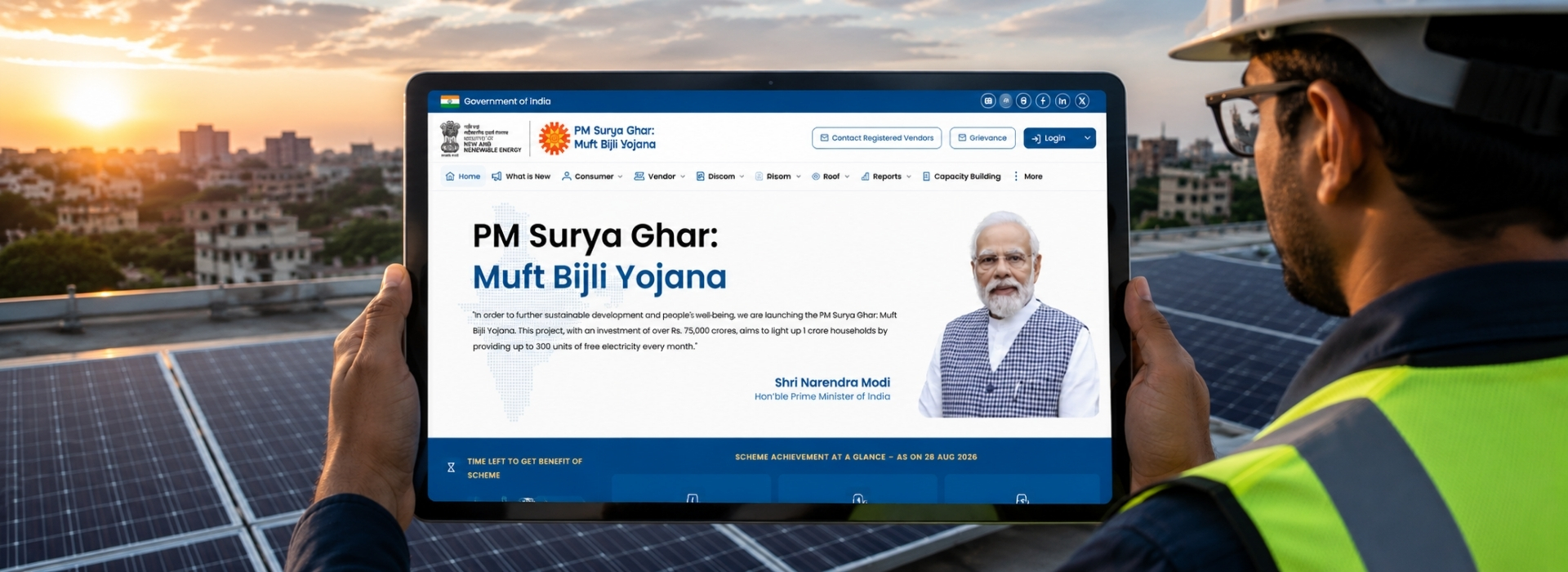
PM Surya Ghar Muft Bijli Yojana: What Solar Buyers Should Know
India’s residential rooftop solar market has received a major boost through the PM Surya Ghar: Muft Bijli Yojana, a Government of India initiative designed to encourage households to generate electricity through rooftop solar.
The scheme was approved in 2024 with an outlay of ₹75,021 crore and aims to support rooftop solar adoption across one crore households. It is designed around the goal of enabling households to receive the benefit of up to 300 units of electricity per month through rooftop solar generation.
For homeowners, solar installers, EPC companies, and dealers, understanding the scheme is important because subsidy eligibility depends on specific technical, installation, and domestic-content requirements.
What Is PM Surya Ghar Muft Bijli Yojana?
PM Surya Ghar is primarily focused on expanding grid-connected residential rooftop solar in India.
Under the scheme, eligible residential consumers can receive Central Financial Assistance (CFA) toward the installation of rooftop solar systems. The financial assistance is linked to the eligible DC capacity of the installed solar module system.
This reduces the upfront investment required from eligible homeowners and makes residential rooftop solar more accessible.
How Much Solar Subsidy Is Available?
Under the published subsidy structure for residential households:
- ₹30,000 per kW is available for capacity up to 2 kW.
- An additional ₹18,000 per kW applies for capacity beyond 2 kW and up to 3 kW.
- The total central subsidy is capped at ₹78,000 for systems of 3 kW or above.
For example, based on this structure:
1 kW system: up to ₹30,000 CFA
2 kW system: up to ₹60,000 CFA
3 kW or higher system: up to ₹78,000 CFA
The final system size should still be selected according to electricity consumption, available rooftop area, sanctioned load, DISCOM requirements, and technical feasibility.
Who Can Benefit from the Scheme?
The CFA component is primarily intended for eligible residential electricity consumers installing grid-connected rooftop solar.
The scheme also provides provisions for Group Housing Societies and Resident Welfare Associations for eligible common facilities.
Commercial and industrial solar projects should not assume that the same residential CFA structure applies to them.
This distinction is important because the Indian solar market includes residential, commercial, industrial, institutional, and utility-scale projects, each of which can be governed by different policies and procurement requirements.
DCR Solar Modules Are Important
One of the most important requirements solar buyers should understand is Domestic Content Requirement (DCR).
For residential rooftop installations seeking CFA under the scheme, the solar modules must satisfy the applicable DCR condition — meaning the modules must meet the requirement for domestically manufactured modules made using domestically manufactured solar cells.
Therefore, buyers should not select modules based only on wattage, price, or technology.
Before procurement, the EPC or installer should confirm that the proposed module satisfies the current scheme requirements and that the relevant manufacturer and product documentation is available.
How Does the Rooftop Solar Process Work?
For a typical residential installation, the process involves several stages.
The consumer first applies through the applicable rooftop solar process and coordinates with the relevant DISCOM. After the required approvals, an eligible rooftop solar system is installed.
The DISCOM then carries out the required inspection and related procedures. Following successful installation, verification, and approval, the applicable CFA can be processed according to the scheme mechanism.
Because requirements can vary by DISCOM and can be updated over time, consumers should follow the latest official process applicable to their location.
Choosing the Right Solar System Capacity
The largest available subsidy should not be the only reason for selecting a particular system capacity.
A rooftop solar system should be designed according to factors such as:
- Monthly electricity consumption
- Available rooftop area
- Roof orientation and shading
- Sanctioned electrical load
- DISCOM requirements
- Module capacity and dimensions
- Inverter configuration
- Future electricity requirements
A properly sized system can provide a better balance between generation potential, available space, investment, and household energy requirements.
What Should Buyers Check Before Installation?
Before finalizing a rooftop solar project under PM Surya Ghar, homeowners should confirm:
- Eligibility under the scheme
- Required system capacity
- DCR compliance of solar modules
- Latest applicable product requirements
- Module technology and efficiency
- Inverter specifications
- Vendor credentials
- Product and performance warranties
- DISCOM approval requirements
- Installation quality
- Applicable subsidy amount and process
These checks can help reduce problems during installation, inspection, and subsidy processing.
Technology Still Matters
Meeting government requirements is essential, but compliance should not be the only consideration when selecting solar equipment.
Buyers should also evaluate the technology and performance characteristics of the proposed modules.
Modern solar modules may offer technologies such as:
- N-Type TOPCon solar cells
- High module efficiency
- Bifacial construction
- Dual-glass design
- High-wattage configurations
The right product should satisfy both scheme requirements and the technical needs of the rooftop solar project.
Why EPC and Product Selection Matter
Government financial assistance can make rooftop solar more accessible, but the long-term performance of the system depends heavily on the equipment and installation.
A residential solar system is expected to operate for many years. Buyers should therefore evaluate the complete solution rather than selecting an EPC or module only on the basis of the lowest quotation.
Module quality, inverter compatibility, structural design, installation practices, warranties, after-sales support, and documentation can all influence the overall rooftop solar experience.
Conclusion
The PM Surya Ghar: Muft Bijli Yojana is an important initiative supporting the growth of residential rooftop solar in India.
Eligible residential consumers can access Central Financial Assistance of up to ₹78,000 under the published subsidy structure, while participating installations must comply with applicable technical and DCR requirements.
For homeowners, the best approach is to understand the scheme first and then select a solar system according to actual electricity consumption, rooftop conditions, technology, compliance, and long-term performance.
For EPC companies, installers, and solar dealers, staying updated with the latest official guidelines is equally important because solar policies and implementation requirements can evolve.