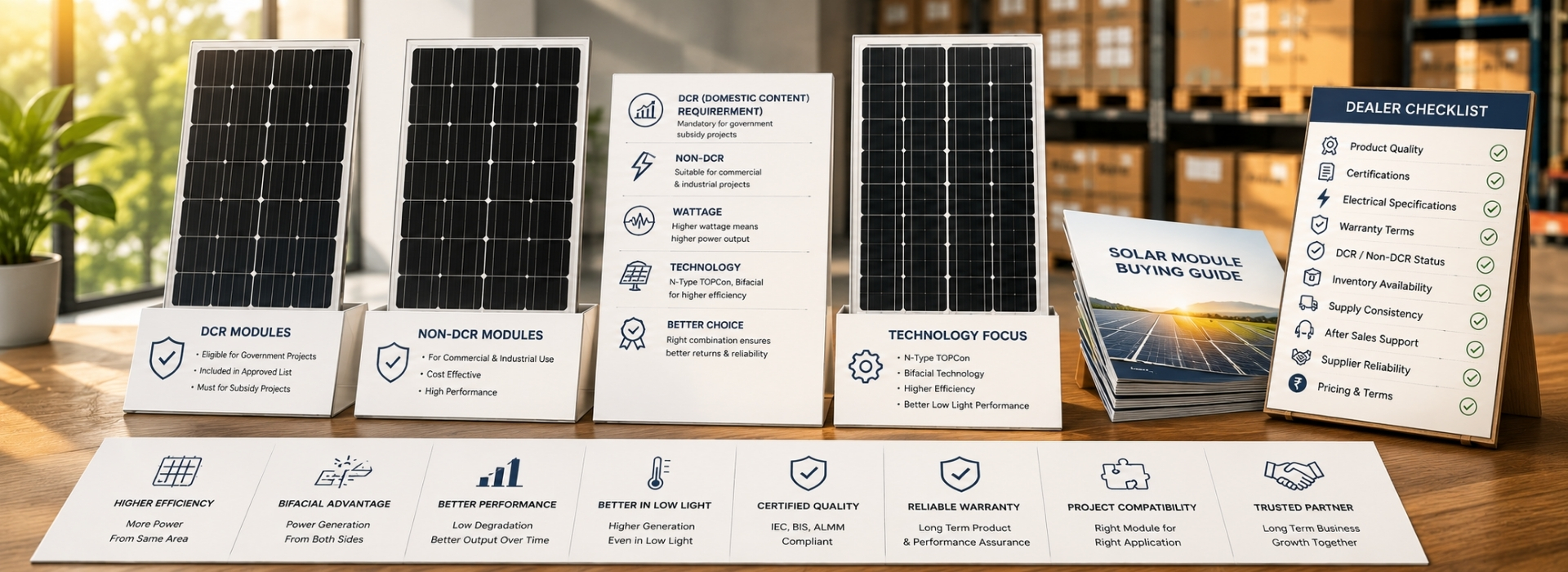
What Solar Dealers Should Check Before Buying Solar Modules
For a solar dealer, purchasing modules is not simply about finding the lowest price or highest wattage.
The modules you stock or supply directly affect your customers, EPC partners, project timelines, and ultimately your business reputation.
With options such as N-Type TOPCon, bifacial, dual-glass, DCR, Non-DCR, and high-wattage solar modules available in the market, dealers need to evaluate products more carefully before placing an order.
A good procurement decision starts with understanding exactly what you are buying — and where it will be used.
1. Understand the Customer and Project Requirement
Before selecting a solar module, understand the type of projects your customers are working on.
A residential rooftop project can have different requirements from a commercial, industrial, or ground-mounted installation.
Ask important questions such as:
- What type of project is it?
- What system capacity is required?
- Is rooftop space limited?
- Is DCR required?
- What inverter will be used?
- What module wattage does the project design require?
- Is bifacial technology suitable for the installation?
This helps dealers recommend products according to actual requirements instead of selling the same module for every application.
2. Check the Solar Cell Technology
Solar technology continues to evolve, and dealers should understand the basic differences between available products.
N-Type TOPCon solar modules have become an important category in the modern solar market because the technology supports high-efficiency and high-power module designs.
When evaluating a module, dealers should understand:
- Cell technology
- Module efficiency
- Rated power
- Temperature characteristics
- Degradation specifications
- Module construction
Understanding these specifications makes it easier to explain product differences to EPCs and customers.
3. Don’t Compare Modules by Wattage Alone
Higher-wattage modules are increasingly available, including products in the 600Wp, 700Wp and 720Wp classes.
For suitable projects, higher power per module can help achieve the required project capacity using fewer individual panels.
But dealers should avoid presenting wattage as the only measure of quality.
A 720Wp solar module is not automatically the best option for every project.
Module dimensions, efficiency, electrical characteristics, weight, available installation space, and inverter compatibility should also be considered.
The better comparison is:
Wattage + Efficiency + Technology + Size + Compatibility
4. Understand DCR and Non-DCR Requirements
Solar dealers in India should clearly understand the difference between DCR and Non-DCR solar modules.
DCR requirements apply to certain government-supported schemes and projects where prescribed domestic-content conditions must be satisfied.
Non-DCR modules may be considered for eligible projects where those specific DCR conditions do not apply, subject to current regulations.
Dealers should never assume that one category is suitable for every customer.
Before supplying material, confirm the project requirement and check the latest applicable rules.
5. Verify ALMM Applicability
ALMM — Approved List of Models and Manufacturers — is another important consideration for applicable solar projects in India.
DCR and ALMM are not the same thing.
A project may have requirements related to DCR, ALMM, or both, depending on its structure and applicable regulations.
Dealers should therefore verify the relevant manufacturer, model, documentation, and latest project requirements before committing material.
This is particularly important when supplying modules for government-linked or regulated projects.
6. Check Electrical Specifications
Solar dealers do not need to design the complete system, but understanding key